
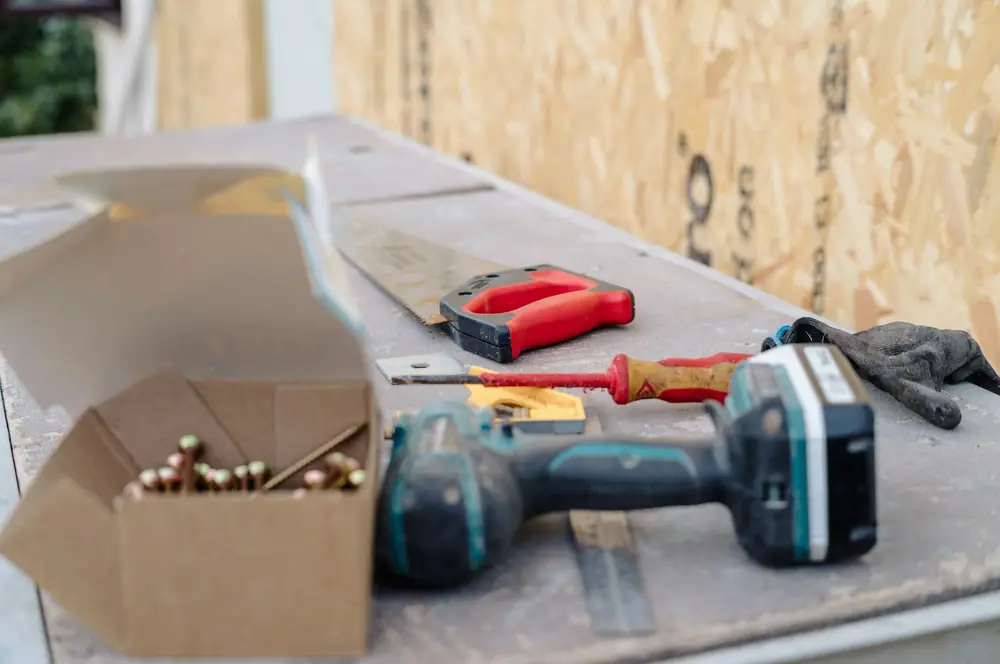
New DIYers often assume that power tools are simply the upgraded version of hand tools. In practice they are different tools for different conditions. A hand saw can be the quicker option for a single cut in a finished room, while a drill/driver is clearly faster when you have forty screws to drive. Knowing which to reach for is a skill in itself.
Five ways to compare
- Control. Hand tools move only as fast as your hand, which makes them forgiving. Power tools amplify small mistakes, such as a drill wandering off its mark or a screw sinking too deep.
- Speed at volume. For one or two operations, the setup time of a power tool (finding the battery, fitting the right bit, setting the clutch) can equal the job itself. For repeated operations, power wins easily.
- Noise and dust. Hand tools are quiet and make larger, heavier chips that are easier to clean up. That is important in flats and occupied rooms.
- Cost and upkeep. Hand tools have no batteries to replace and can last decades. Power tools need chargers, batteries and occasional brushes or repairs.
- Learning value. Hand tools teach you how materials behave: how wood splits, how a screw bites, how much force a nut needs. That feel makes you better with power tools later.
Task-by-task comparison
| Task | Hand tool | Power tool | Usually quicker |
|---|---|---|---|
| Drive 2–3 screws in a hinge | Screwdriver | Drill/driver | HAND |
| Assemble a flat-pack wardrobe | Hex key, screwdriver | Drill/driver on low clutch | POWER |
| Cut one shelf board | Crosscut hand saw | Circular saw | EITHER |
| Cut ten decking boards | Hand saw | Circular saw with guide | POWER |
| Drill a hole in plasterboard for an fixing | Hand drill / gimlet | Drill/driver | POWER |
| Trim a door that sticks | Block plane | Electric planer | HAND |
| Remove rust from a tool | Wire brush, abrasive pad | Rotary tool with brush | EITHER |
| Hole in concrete | Star drill and hammer | Hammer drill | POWER |
The hybrid habit
Experienced DIYers mix both within a single job. A common pattern for hanging a shelf: find and mark studs by hand, drill pilot holes with the drill/driver, drive the first screws with the driver on a low clutch setting, and snug the last quarter turn by hand with a screwdriver so you can feel when it is tight. The power tool does the repetitive work; the hand tool provides the finish.
Another example is cutting mouldings. A mitre saw or a guided hand saw makes the main cut, then a block plane or sanding block takes off the last millimetre or so for a tight fit. Trying to "sneak up" on a line with a power saw usually removes too much.
Choosing your first power tools
If you are starting from hand tools, the first power tool should be one that replaces the most tiring repetitive task. For most homes that is driving screws and drilling holes, so a cordless drill/driver comes first. A jigsaw is a sensible second choice because it cuts curves and sheet materials safely at modest speed. Circular saws, routers and grinders are powerful and useful, but they reward experience and should wait until you have a clear need and have practised with the simpler tools.
Safety differences
Hand tools injure through slips: a screwdriver skidding off a screw, a chisel pushed towards your hand, a knife drawn towards your body. Power tools add speed, kickback and noise. Eye protection applies to both. For power tools add hearing protection, a secure grip with two hands where designed, and a habit of removing the battery before changing blades or bits. Our safety gear guide has a printable checklist.
Quick decision checklist
- Fewer than five repeats? Try the hand tool first.
- Working in an occupied room or late in the day? Favour quiet hand tools.
- Material is hard (masonry, thick hardwood)? Use power.
- Is the final fit critical? Finish by hand.
- Unsure how the material will react? Test on scrap with a hand tool.