
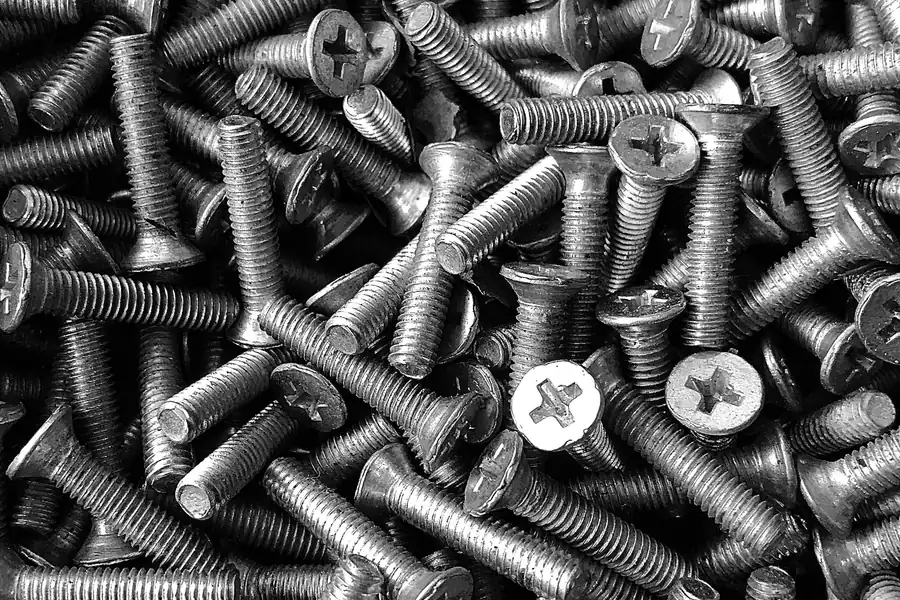
Look closely at the heads of the screws in your fastener box and you will find several shapes of recess: a cross, a square, a six-pointed star, perhaps a simple slot. Each is called a drive type, and matching the bit exactly to the drive is one of the quickest ways to make driving screws easier and more reliable.
The common drive types
| Drive | Shape | Common sizes | Where you will see it | Grip |
|---|---|---|---|---|
| Slotted | Single straight slot | 5.5, 6.5 mm | Older hardware, cover plates | LOW |
| Phillips | Cross with tapered sides | PH1, PH2, PH3 | Plasterboard screws, some furniture and appliances | MEDIUM |
| Pozidriv | Cross with extra tick marks | PZ1, PZ2 | Most wood screws sold in UK DIY shops | MEDIUM+ |
| Square (Robertson) | Square recess | #1, #2, #3 | Less common in the UK; some imported construction screws | HIGH |
| Torx (star) | Six-lobed star | T15, T20, T25, T30 | Decking screws, appliances, automotive | HIGH |
| Hex socket | Six-sided recess | Metric and inch keys | Flat-pack furniture, machinery | HIGH |
What cam-out is and why it happens
Cam-out is when the driver rides up and out of the screw recess under torque. The tapered sides of a Phillips recess make this more likely: as you turn harder, the bit is pushed outward. The result is a chewed screw head, a damaged bit and sometimes a scratched surface or a slip that sends the driver into your other hand.
Pozidriv and Torx recesses have more vertical walls, so the force stays rotational instead of pushing the bit out. That is why they are popular for construction and decking screws, which are long and need more torque.
Preventing stripped screws
- Use the exact size. A PZ1 bit in a PZ2 screw, or a Phillips bit in a Pozidriv screw, will strip it almost immediately. The bit should seat deeply with no wobble.
- Push, then turn. Firm, straight pressure in line with the screw is more important than torque.
- Drill a pilot hole in hardwood and near the ends of boards, so the screw needs less force.
- Lower the clutch on your drill/driver and finish the last turn by hand if needed.
- Replace worn bits. Rounded bits are a main cause of cam-out.
- Do not mix up Phillips and Pozidriv. They look similar but the geometry differs; each fits its own screws properly.
Removing a stripped screw
If a head is already damaged, try these in order: press a wide elastic band between the bit and the screw head for extra grip; switch to a slightly larger bit or a different drive type that happens to fit; tap a screw extractor into the head following its instructions; or, for a protruding head, grip it with locking pliers and turn slowly. Wear eye protection, since extractors and hardened screws can snap.
A sensible driver bit kit
- Pozidriv PZ1, PZ2 (several), PZ3
- Phillips PH1, PH2, PH3
- Torx T10, T15, T20, T25 (several), T30
- Slotted 5.5 mm and 6.5 mm
- A magnetic bit holder, which also makes one-handed screw starting easier
- A small metric hex (Allen) key set, plus imperial sizes if you have older or imported kit
Keep the bits in a case with labelled slots, and store the most-used sizes in a belt clip or on the drill itself. When buying screws for a project, it is worth choosing Torx drives where available, especially for longer screws. For more on the fasteners themselves, see our fasteners and wall plugs guide.
Before you drive
- Identified the drive type by looking closely at the recess
- Bit size seats fully with no wobble
- Pilot hole drilled where needed
- Clutch set low for small screws; test on scrap
- Worn bits removed from the kit